Roberts Guest Lectures

by Michael T. Roberts

I had the opportunity to guest lecture on historical perspectives involving food law and Covid-19 via Zoom in two classes last week. The first lecture/discussion was at the University of Arkansas School of Law’s LL.M. program series sponsored by Professor Susan Schneider on Food, Law, and Covid-19. My presentation title was on “Learning from the Past: Pandemics and Food Security in Historical Context.”

The second lecture/discussion was here at UCLA in Professor Monica Smith’s anthropology class on Covid-19 Foodways: Changes and Challenges for the Future. I presented on legal perspectives on Covid-19 changes in the context of the development of international food law in the 20th century. 

These opportunities have underscored for me how understanding the history of food security and the development of modern food law is critical as we move to the future.

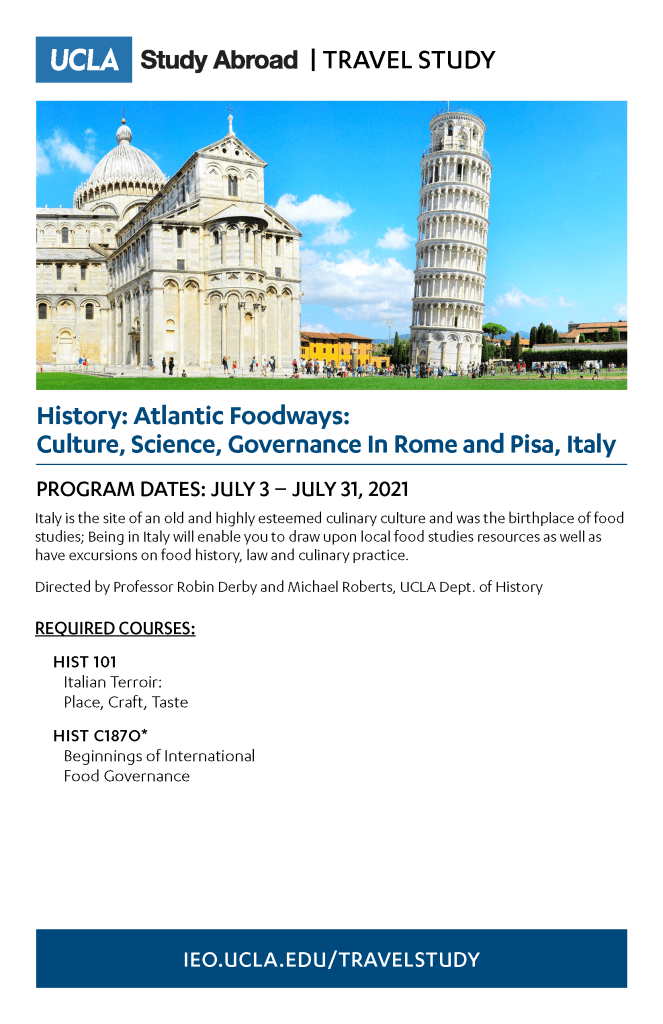
Study Food History and Culture in Italy With UCLA Next Summer

Aaahhh, travel. Let’s dream of July in Rome, experiencing Italy’s food culture and learning Italian food history through the concept of terroir. Study this complex food culture with Robin Derby, Professor of History, UCLA, and Michael Roberts, Executive Director of the Resnick Center for Food Law & Policy, observing sustainable food production, tasting local cuisine, and learning about the emergence of international food governance through the twentieth century. Click here for more information.

Guide to Food-Based Pro Bono Activities

by Diana Winters

The Resnick Center is excited to share the publication of “Setting the Table for Food-Based Pro Bono Opportunities: A Resource Guide for Pro Bono Attorneys,” authored by Tommy Tobin, a member of the Resnick Center’s Advisory Board, and MAZON: A Jewish Response to Hunger. The guide is designed to facilitate connections between attorneys seeking meaningful pro bono work and anti-hunger organizations.

The Covid-19 pandemic has exacerbated food insecurity in the United States, and the amount of resources needed to address the crisis is staggering. Attorneys seeking pro bono work can assist with direct client services, legislative research, and policy advocacy, among other things. This guide seeks to describe these opportunities and to assist in forming these partnerships.

We are grateful to Tommy Tobin, Mazon, and Perkins Coie LLP for their work on and support of the guide. The guide will be updated periodically.

Addressing Honey Fraud and the Pollination Crisis

by Diana Winters

The scope of honey fraud is enormous.  Demand for honey has doubled in the U.S. in the past 25 years, but production has not kept up. The increase in demand for honey has coincided with a critical decline in honey bee populations globally.    So to keep consumers’ honey pots full with cheap honey, producers have increasingly cut honey with cheaper substances like corn syrup.

As adulterated honey takes over the mass market, beekeepers and legitimate honey producers cannot recoup their expenses by selling pure honey and are going out of business.  The loss of these businesses has dire consequences for our declining honeybee population, which in turn has repercussions far beyond honey production. 

Those trying to solve these two problems—honey market fraud and the loss of bee populations—must recognize that they are inextricably linked.  The failure to do so may be catastrophic. This is because the decline in honey production is the least of our worries when it comes to declining honeybee populations; the consequences of reduced pollination are far worse.  Three out of four fruit or seed crops need pollinators to continue producing, and the loss of bees has led to what some see as a pollination crisis.

Commercial beekeepers’ revenue comes from the sale of both honey and pollination services.  When beekeepers go out of business because they cannot compete on price with honey producers mixing cheaper products into honey, they also cease providing pollination services. 

But this linkage has not been effectively addressed by policymakers. One reason is that the declining honeybee population is seen as an environmental problem, while fraud is an economic one, and these problems are addressed by different federal agencies.  Notably, a 2014 effort by the White House to address the pollination crisis did not include the FDA, the only agency with the authority to address honey adulteration.  Moreover, the FDA’s approach to honey fraud has been anemic.  It focuses on labeling rather than stronger action like setting out a specific formula or method of production for honey.  

Michael T. Roberts, Executive Director of the Resnick Center for Food Law and Policy at UCLA Law School, has published a white paper with the support of the American Honeybee Producers Association that identified an approach to stopping honey fraud while also saving the honeybee.

First, federal agencies—including the FDA, the USDA, and the EPA— must work together to adopt food-systems thinking with the twin goals of addressing pollination and honey production.  If the White House fails to order coordination among these entities, Congress should legislate this coordination.  And regardless of whether the White House or Congress act, the FDA should take immediate action against honey fraud.  Next, retailers should work with the American Honey Producers Association to develop strategies to address honey fraud and to save pollinators.  For example, in the absence of governmental standards, retailers should consider creating private standards in the supply chain to counter fraud. 

Moreover, all the stakeholders in this pollinator economy—including regulators, retailers, and beekeepers—must educate the consumer on the value of unadulterated honey. 

Currently, there are overwhelming incentives and an absence of consequences for food manufacturers to engage in honey fraud, and this takes a vast toll on consumers, the legitimate honey producer, and pollinators.  To fix this, we must make the connection between healthy pollinator populations and pure, authentic honey as clear to everyone as it is to beekeepers and legitimate honey producers.

Resnick Center faculty and staff recent speaking events

Executive Director Michael T. Roberts recently spoke by Zoom for the San Marino Rotary Club on the “Role of Food Law in everyday consumer products: Olive Oil and Honey. How do we know what’s in our plates?” Regarding the presentation, he commented, “I was thoroughly impressed with the quality of questions from the members. We ran 30 minutes overtime, as questions about Ractopamine (animal drug) and Isotopes (chemical fingerprinting) surfaced.” A video of the talk is here.

Also this week, Assistant Director Diana Winters participated in a Duke Law Food Law Society Zoom panel on Slaughterhouses and Covid-19, with David Muraskin from Public Justice, Hannah Connor from the Center for Biological Diversity, and Delcianna Winders, the Director of Lewis & Clark Law School’s Animal Law Litigation Clinic. The panel discussed failures in food safety and worker protection regulation that have led to the rampant spread of Covid-19 in meat processing plants.

Webinar: Impacts of COVID-19 on Food Security and Long-term Implications and Adaptations

by Diana Winters

On September 18, I attended a webinar hosted by the Center for Urban and Regional Analysis at Ohio State University on the impacts of Covid-19 on food security. The panelists included Kip Curtis, an Associate Professor in the Department of History at OSU, Mary Rodriguez, an Assistant Professor in the Department of Agricultural Communication, Education, and Leadership at OSU, Brian Snyder, the Executive Director of the Initiative for Food and Agricultural Transformation (InFACT) at OSU, and Lauren Vargo – a Program Manager at Case Western Reserve University.

The panelists discussed the enormous impact of Covid-19 on family decision-making concerning food, and the increase in the use of federal and state food assistance benefits. Rodriguez described how families had to shift their buying habits because of the pandemic. Although official advice was to acquire two weeks of food, many families had neither the financial capacity nor the infrastructure to do so, and had to shift their diets accordingly. Curtis, an environmental historian, discussed the growing importance of local food production, in the context of many crises–not just the pandemic.

Snyder analogized the food system to a river, which had reduced water flow because of the pandemic. This drop in water level exposed hazards in the system that were always there, but hidden. For example, the public became aware of shortages and surpluses in the supply chain, as well as bottlenecks and dams in production, processing, and distribution. Worker issues became visible, especially in the area of meat processing, as production slowed because of rampant disease spread amongst closely packed individuals. Moreover, the fact that approximately 50% of farmworkers are undocumented disincentivized testing and treatment, which leads to more disease spread.

Vargo pointed out how much more food is in the media now, and this webinar highlighted how food and food systems became critically important during the Covid-19 pandemic, which is by no means over. There is no more important time to address the hazards in our food supply, to prepare us not just for future crises, but for the present.

Retail Water Rates and Community Gardens in Los Angeles

Welcome back to On Food Law! We are excited to be back from our summer break and can’t wait to see what the rest of 2020 will bring. (Kidding.)

We have some exciting news – Laura Yraceburu Dall’s (UCLA Law ’20) article on the effect of Proposition 218 on retail water rates for community gardens in Los Angeles, which won the 2020 California Water Law Writing Prize co-sponsored by the California Water Law Symposium Board of Directors and the University of the Pacific, McGeorge School of Law, has been published in the California Water Law Journal.

Laura, who was deeply involved with the Resnick Center during her time at UCLA Law, writes that she came to the topic in her Food Law & Policy Clinic:

“As a part of Professor Korn’s Food Law and Policy Clinic, a representative of the Los Angeles Food and Policy Council came to discuss her advocacy and mentioned that water rates for community gardens were increasing by nearly three hundred percent, threatening the existence of gardens to the detriment of low-income community members. I began researching outside of class and came to realize that there was no clear understanding of why the rates were increasing so dramatically. I knew that I had to write about it.”
She then wrote the paper for her water law course, and submitted it for the 2020 CA Water Law Writing Prize.
Here is a synopsis of the paper:

Community gardens in Los Angeles County have seen water rates increase from a flat rate of $1.41 per hundred cubic feet (HCF) in March 2016 to $2.095/HCF plus variable adjustments in July 2019 – a 289 percent increase.[1] As a result, some community gardens have been forced to quadruple their member gardeners’ monthly dues to cover the increasing cost of water.[2] In three years, this increase in the price of water has made gardening significantly more expensive and has priced out low-income, largely immigrant community members[3] who rely on these gardens to supplement their diets with fresh produce. Community gardens across Los Angeles now face the choice of either having their membership change from subsisters who rely on the gardens for dietary needs to hobby gardeners who can pay more to fund the gardens or, alternatively, closing their operations.  Either result increases food insecurity for the most vulnerable members of the gardens’ communities.

California has a long history of resisting tax increases through voter-approved propositions, known in short-hand as the California Tax Revolt. This effort has generally made it more challenging for cities and utilities to raise needed revenue for local services and programs, including water service,[4] but a deeper problem exists than a shortage of funds. Proposition 218, which amended the California Constitution, imposes substantive and procedural requirements on local agencies by limiting property-related fees, including retail water rates.[5]  Proposition 218’s shifting of rate setting authority to the electorate has paradoxically contributed to a significant water rate increase for Los Angeles’ community gardens.  While the goal of the Tax Revolt was to keep taxes and rates low, certain ratepayers have not received such benefits and in fact have experienced disproportionate rate increases.

This paper begins with an overview of community gardens and the history of the California Tax Revolt, primarily focusing on Propositions 13 and 218.[6]  Next, this paper will evaluate Proposition 218’s consequences for community gardens in the Los Angeles area. An analysis of how Proposition 218 was sold to voters will follow. A discussion of practical steps towards reform will precede the conclusion.[7]


This important work can be found here.

Guide to Careers in Public Interest Food Law and Policy Published

By Diana Winters

A food law and policy career, especially for attorneys interested in working in the public interest sector, can take many shapes. Food policy work often intersects with other legal subject matters, such as housing, health care, education, and family law. For this reason, the Resnick Center has put together a digital guide to Careers in Public Interest Food Law and Policy to help law students and graduates understand the varied directions a public interest food law career can go, and how to embark upon such a career path.

Although the guide contains some resources specific to UCLA Law students, it also contains many more general resources, and will be useful to all law students and law school graduates seeking to explore public interest food law and policy careers.

We’re excited about this guide, and hope it can help grow our vibrant field.

Not labeled for retail sale, except during the coronavirus pandemic

By Daniel Pessar* (Guest Blogger)

This is the third in a series of occasional posts by Daniel Pessar on regulatory flexibility in the context of food law and the pandemic.

The novel coronavirus pandemic has led to health, economic, and political turmoil around the world. In response to this public health crisis, U.S. federal, state, and local governments have been seeking to contain the impact of the virus while minimizing the collateral economic impact. Although stay at home orders and social distancing rules have had the greatest impact on people, many laws, regulations, and rules have been suspended or relaxed in order to help individuals and organizations—especially those involved in the pandemic response—to be productive during these difficult times.

One agency relaxing regulatory measures is the U.S. Food and Drug Administration (FDA) which has been working to remove obstacles to the flow of essential goods throughout the economy. As supply chains have been disrupted and demand patterns have shifted, the FDA has worked to relax the enforcement of certain regulations which could slow the response of food manufacturers and distributers to the new food business landscape.

In March 2020, the FDA announced that it would relax the enforcement of certain labeling laws that are familiar to many shoppers who purchase packaged goods in bulk. These shoppers know that often the individual beverage containers or snack bags do not have the product’s nutrition information. Instead, they have a label which reads “This unit not labeled for individual sale” or some variation of that announcement. Labeling items within a multi-pack in this way gives manufacturers more flexibility in package aesthetics and design and can help a food business to better control the flow of products for retail sale. Retailers interested in selling these items individually would need to affix a compliant nutrition label on top of the manufacturer’s label to comply with federal law.

In addition to multi-unit packaged goods, FDA nutrition labeling regulations also provide exceptions for food served in most restaurants or in other establishments in which food is served for immediate human consumption (e.g., institutional food service establishments, such as schools, hospitals, and cafeterias; transportation carriers, such as trains and airplanes; bakeries, delicatessens, and retail confectionery stores where there are facilities for immediate consumption on the premises; food service vendors, such as lunch wagons, ice cream shops, mall cookie counters, vending machines, and sidewalk carts…)  21 CFR § 101.9(j)(2)(ii)

These exceptions do not give restaurants a blank check, however. Only food served for immediate human consumption may be served without the inclusion of the necessary nutrition information. Under normal circumstances, these regulations do not limit restaurants—they are in the business of serving food for immediate human consumption after all.

Yet all of the upheaval that has come with the coronavirus pandemic has turned this law into a costly obstacle to offloading excess ingredient inventory. Food establishments with extra meat, flour, or cheese—but fewer customers—might consider selling packages of supplies directly to customers in order to reduce the economic pressures they are facing. However, given that these supplies would not qualify as food for immediate human consumption, the restaurants would need to ensure that an appropriate label be designed and affixed to the food parcels. Further compounding this challenge is the fact that the large packages sent to the restaurants by manufacturers or distributers of food supplies often lack nutrition labeling as well—those companies qualify for a separate exception from nutrition labeling regulations (see 21 CFR § 101.9(j)(2)(v)).

Recognizing that this rule would hurt restaurants while reducing the amount of food being made available to consumers during the pandemic, the FDA stepped in to temporarily relax certain rules. In March 2020, The FDA issued a temporary policy to relax labeling requirements for restaurants seeking to sell these kinds of products. As long as the food was labeled with (1) statement of identity, (2) ingredient statement, (3) name and place of business of the food manufacturer, packer, or distributer, (4) net quantity of contents, and (5) allergen information, the FDA would not object to the product’s sale even if it lacked a Nutrition Facts label.

Other rules have not been suspended, however. Restaurants making nutrient content claims about these food products (“Low fat cheese” or “High fiber beans”) would face other labeling rules that have not been relaxed by the FDA’s temporary policy. In addition, the FDA guidance does not apply to any foods prepared by restaurants. Entrepreneurs interested in developing packaged foods to supplement their restaurant offerings during the pandemic will need to comply with the robust label requirements for packaged foods. But as long as the new guidance stays in effect, restaurants can more easily sell packaged foods—both perishable and non-perishable—from cooking oil and tomato sauce to snack packs and juice pouches.

As restaurants, bars, and bakeries see a dramatic slowdown in business, some are trying to capitalize on their supply chain to maintain some business activity. For example, Fort Defiance, a bar in the Red Hook section of Brooklyn, New York, now sells a range of food supplies online including cheese, tofu, and raw chicken.  The FDA’s new stance facilitates this flexibility.

*Daniel Pessar is a third-year student at Harvard Law School. Before law school, he worked in the real estate investment industry for six years. He is the author of three books and numerous articles. He can be contacted at dpessar@jd20.law.harvard.edu

Website Powered by WordPress.com.

Up ↑