The intersection of pedagogy and practice: an interview with Duke Law Professor Allison Korn

By Lavanya Sathyamurthy*

In law school classrooms across the country, professors and students grapple with society’s most challenging issues and how to address them through the legal system. How can we ensure access to reproductive healthcare after the Supreme Court eliminated the constitutional right to abortion inDobbs v. Jackson Women’s Health Organization? How can we meet the needs of our unhoused population when several cities, including Los Angeles, have passed ordinances that ban camping on public property, criminalizing homeless encampments? Through these discussions, students are introduced to important concepts such as community lawyering, which encourages lawyers to work collaboratively with impacted communities, and cultural competency, which describes the ability to work effectively with people from different backgrounds. Theoretical discussions in seminars provide the basis for how students will eventually approach social justice issues in practice. However, the most fruitful learning opportunities arise at the intersection of pedagogy and practice, in clinical courses.

Clinical courses are a cornerstone of the law school curriculum. In the classroom, students learn both legal theories, such as abolition in the criminal context, and practical skills, such as client interviewing and legal research. In the field, they apply this knowledge to serve clients, taking on primary responsibility for every aspect of their case. Through these courses, students learn how to translate theory into practice to zealously advocate for their clients. Clinics also serve an important role in the community, offering assistance to and building relationships with local marginalized populations.

Continue reading “The intersection of pedagogy and practice: an interview with Duke Law Professor Allison Korn”

To Eat or Not to Eat: For Consumers in a City Without a Food Allergen Ordinance, The Choice Could Be Life or Death

by Melissa Deng*

For many of us without food allergies, we don’t think twice about choosing to dine at a restaurant or order take-out––often, the biggest concern is picking which restaurant you feel like eating at, what to order, and comparing costs.  But for individuals with food allergies, the choice between dining in and ordering out can mean life or death.  Even so, cities you might think are more “food allergy-friendly” like Los Angeles, which has a colloquial reputation for having a vibrant food scene, may not have an ordinance specifically governing food allergen training in restaurants––even while more than fifty percent of adults with food allergies and over forty percent of children with food allergies in the United States have experienced a severe food allergic reaction (of note is that emergency treatment for anaphylaxis resulting from a food allergic reaction increased by 377 percent between 2007 and 2016). 

What gives?  For starters, the restaurant industry is of course profit-driven, and restaurant associations have a significant impact on lobbying for or against legislation.  From an economic perspective, restaurant management might be wary of the increased costs an ordinance specifically mandating food allergen training would impose, compounded by the fact that the restaurant industry generally experiences high turnover (reportedly, there was a 28% average turnover rate for restaurants in LA last year).  From a legal perspective, restaurants might not want to face increased liability: with an ordinance that mandates training, plaintiffs can more easily make a prima facie case of negligence by showing that the restaurant’s conduct deviated from an established standard of care.  And from a psychological perspective, restaurant staff might have misconceptions about their role in preventing food allergic reactions (for example, believing that the onus falls solely on customers to order a dish that doesn’t have food allergens) and might not realize the potentially fatal consequences, such as anaphylaxis resulting from a food allergic reaction.   What this means is that consumers with food allergies are unfairly subjected to a burdensome and dangerous dining experience where each restaurant chooses which food allergen procedures to follow and to what degree. 

It is precisely this issue that drove us at the Resnick Center for Food Law & Policy, in collaboration with a professor and clinical immunologist at UCLA, to begin collecting both hospital-based and anecdotal evidence on instances of food-related anaphylaxis in the city, and pursuing the task of proposing a food allergy ordinance in the City of Los Angeles that will mandate a separate food allergen training for all restaurant employees in the city.  In the beginning stages of the project, we sought to answer two underlying questions: how do restaurants communicate allergen information to their consumers; and are they effectively training their personnel in allergen disclosure for menu labeling or food handling?

Continue reading “To Eat or Not to Eat: For Consumers in a City Without a Food Allergen Ordinance, The Choice Could Be Life or Death”

Food, community, and belonging: Our Seat at the Table

by Marin Milken*

[This is one in a series of occasional posts by Los Angeles high school students working with and studying food systems.]

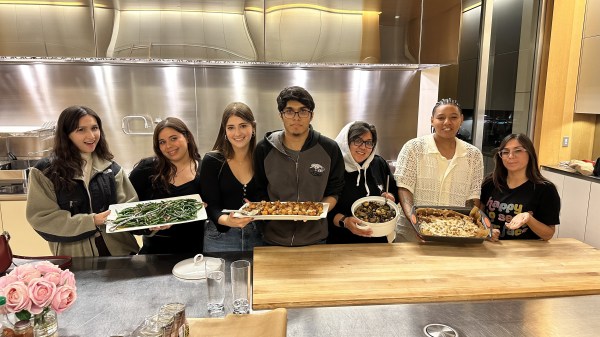
Inspired by the meals I made for my family and friends during the pandemic, I founded Our Seat at the Table to engage with questions of food, community and belonging. Though there are various food-related initiatives that Our Seat will continue to tackle through its programming, I wanted our first endeavor to help with the widespread national issue of food insecurity. Food insecurity, in simplest terms, is when people neither have enough to eat, nor know where their next meal is coming from. The latest State of Food Security and Nutrition in the World (SOFI) report indicates that in comparison to 2019, the number of people worldwide affected by hunger has risen by over 122 million. In the United States, food insecurity is addressed through Supplemental Nutrition Assistance Program (SNAP) benefits, which aim supplement low-income families’ groceries, so that they can access the food that they need to be food secure. But key findings in a recent report from the Robert Wood Johnson foundation highlight and demonstrate that SNAP benefits don’t cover the cost of moderately priced meals in 78% of US counties. With this statistic in mind, it’s unlikely that SNAP benefits are able to cover the costs of healthier options, such as organic produce. Programs such as SNAP – and its inability to adequately address the food needs for so many in this country – highlight a large systemic gap between those who are food insecure and food secure, despite SNAP being touted as a successful safety net for those who are food insecure.

Continue reading “Food, community, and belonging: Our Seat at the Table”

Discovering agricultural careers with the USDA: a summer program for teens

by Rosalie Winters*

[This is one in a series of occasional posts by Los Angeles high school students working with and studying food systems.]

This summer I attended the AgDiscovery program at Lincoln University in Jefferson City, Missouri. AgDiscovery is a program for high school students, and it is run by the USDA at multiple land grant universities nationwide. It aims to help teenagers explore careers in agricultural sciences. Each program across the country is unique, specializing in animal science, plant science, agribusiness, or a combination of the three, with pieces added that may explore topics like agricultural history or urban farming. You are only allowed to apply to one school, so it is important to choose one that includes things you are passionate about. The program at Lincoln is a combination, providing students with an introduction to the many moving parts that make up the country’s agricultural systems. This appealed to me because while I was very interested in agriculture, I knew almost nothing about it. 

The program at Lincoln included four distinct components. The first of these was a lecture series on varying agricultural topics. For example, we heard an etymologist speaking about different invasive species of insects and how they can affect various crops; a speaker discussing native plants and showing us some of the different species native to Missouri; and had a lesson on scientific writing and how to put together research. These informative lectures allowed us to gain a background for the things that we were seeing and experiencing in person. 

Continue reading “Discovering agricultural careers with the USDA: a summer program for teens”

Exploring the Legal and Policy Implications Behind ‘High on the Hog’: Potential Solutions Forward (Part 4 of 4)

There are a variety of policy solutions that have the potential to help elevate and preserve Black cuisine and resolve inequities faced by Black Americans in the American food system. This post will explore ideas that relate to the preservation of Black culinary tradition, supporting Black farmers and culinary professionals, and increasing the access of culturally-relevant foods to Black communities in order to honor the richness of America’s culinary landscape. 

Preservation of Black Culinary Traditions

The preservation of Black culinary traditions is important to ensure that Black communities are able to celebrate their cultural heritage and to allow for greater recognition of Black people’s contributions to the culinary world. Initiatives like funding programs and grants to support culinary research, education, and documentation of traditional Black food practices could help with this cultural preservation. Furthermore, educational initiatives that introduce Black American cuisine into school curricula have the ability to educate young people about the cuisine’s significance and influence on American food. FoodCorps is an AmeriCorps grantee that has begun undertaking this type of initiative. During black history month of this year (February 2023), the organization held educational programming at elementary schools which taught black history through a culinary lens. 

Continue reading “Exploring the Legal and Policy Implications Behind ‘High on the Hog’: Potential Solutions Forward (Part 4 of 4)”

SUMMER 2024 JOB POST! Earthjustice Sustainable Food and Farming Law Clerkship

Earthjustice’s Sustainable Food and Farming Program engages in litigation and advocacy to improve our nation’s food system, from crop selection and farming practices to food processing and sustainability.

Currently enrolled law students are eligible to apply. Applications are due by September 4, 2023. 

Continue reading “SUMMER 2024 JOB POST! Earthjustice Sustainable Food and Farming Law Clerkship”

Exploring the Legal and Policy Implications Behind ‘High on the Hog’: The Rise of Black Culinary Tradition (Part 1 of 4)

This four-part blog series is inspired by the Netflix docu-series, “High on the Hog: How African American Cuisine Transformed America.” I will delve into the legal and public policy implications behind the narratives presented by series host, Stephen Satterfield, throughout the show’s four episodes. This blog series aims to explore the impact of laws and policies on the development and preservation of Black Americans’ culinary heritage. 

There’s little doubt that the history of slavery in the Black American story is a factor in the culture’s culinary development. “Soul food is the African-American version [of comfort food] —  a cuisine forged during several centuries as a response to persistent trauma from slavery and oppression,” says lawyer, public policy advisor, and culinary historian Adrian Miller

Continue reading “Exploring the Legal and Policy Implications Behind ‘High on the Hog’: The Rise of Black Culinary Tradition (Part 1 of 4)”

The importance of food literacy

by Rose Sarner* (Guest Blogger)

“It’s one thing to provide people with food and it’s another to teach food literacy.” According to Fast Company, in 2021, “54 million Americans do not have access to healthy food,” and according to NPR, “80 percent of Americans fail to eat the recommended amounts of fruits and vegetables.”  

Healthful food and its many benefits are not an everyday reality for many families in the world. Here in the United States, young kids, teens, and adults have little knowledge about the foods they are putting into their bodies, where the food is coming from, or how different foods affect their overall health. The programs that are in place that are supposed to “educate” Americans are not engaging, clear, or very informative and this failing has contributed to the current health and obesity crisis in the United States. Making health sustainable is a multifaceted issue that has many layers. Many individuals fall short of taking care of their health issues because they do not know how to make a life switch and sustain their progress. 

Our schools can play an important role in changing dietary habits by educating students on food literacy.  According to The Centers for Disease and Prevention, “US students receive less than 8 hours of required nutrition education each school year, which is far below the 40–50 hours that are needed to affect behavior change.” Additionally, educators are encouraged to teach nutritional education classes at schools; however, given the important role a person’s consumption of healthy foods has in preventing chronic diseases and supporting good health, ideally, educators would provide students with more hours of nutritional instruction. Research has proven a connection between healthy diets and one’s emotional well-being, and how emotions may influence eating habits (The Centers for Disease and Prevention). Due to the large number of required classes in many schools across the country, administrators and teachers should consider ways to integrate nutrition education into their existing curriculums.  

Continue reading “The importance of food literacy”

Service with FoodCorps

by Lucy Weiss*

With a background in Food Studies, an interest in food law and policy, and a belief in the power of education, I was searching for ways to combine my passions when a professor recommended FoodCorps to me. FoodCorps is an AmeriCorps service fellowship program focusing on student access to healthy food in schools that partners with local community organizations and school districts around the U.S. Service members participate in three primary activities: providing hands-on lessons, encouraging healthy school meals, and promoting a schoolwide culture of health. For example, members teach gardening and cooking and facilitate taste tests of new and different foods, although the COVID-19 pandemic limits some of what we are able to do. A number of service members also work with the cafeteria staff and school districts to ensure healthy food options are available and promoted at school lunches. Each state and site partner have different needs and therefore service varies from position to position. 

Continue reading “Service with FoodCorps”

Website Powered by WordPress.com.

Up ↑