
Regional spotlight: Food Equity in Pennsylvania

The following is a guest post by Mallory Hersh* about her work in food equity.

During the pandemic, I had more free time than expected, and began to cook to accommodate my father’s recently-diagnosed food allergies. A few successful dinners later, I was whipping up healthy treats and baked goods in my spare time and delivering them around the neighborhood. 

But as I became more involved in conversations about food–how to source organic ingredients; the best forums for recipe swaps–I became increasingly aware that not everyone had the same access that I did to the foods that I took for granted. In the U.S., more than 34 million people, including 9 million children, experience food insecurity, often lacking consistent access to nutritious meals. Looking to help make a difference, I got involved with my high school’s service club, specifically aiming to spend my time with local community fridges and food pantries. I was selected to be the liaison between my school and Weaver’s Way Community Fridge, a community fridge that was connected to a local grocery store in Ambler, Pennsylvania.

Continue reading “Regional spotlight: Food Equity in Pennsylvania”
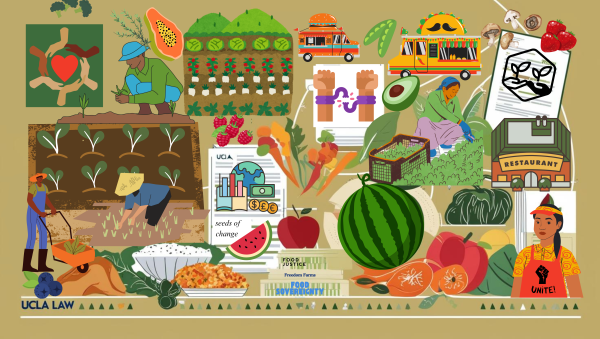
Introducing the Food, Race, and Equity Initiative

by Heliya Izadpanah and Lavanya Sathyamurthy*

This is Part I of a two-part post.

Dreaming of Food Justice in Law

By Heliya Izadpanah

UCLA Law was my dream school. Like many law schools, it catered to my interests in human rights law and environmental law. But what made the decision to attend UCLA Law a no-brainer were two rare institutional assets–its groundbreaking Critical Race Studies program paired with one of the few Food Law programs then existing in the nation.

I was a passionate advocate for food systems justice. We all interact with food daily, yet its production and distribution are rarely observed in modern society. People often don’t know the conditions under which their food is produced or the legal machines maintaining these systems. But when it comes down to it, it’s virtually impossible to identify even a single food item that isn’t riddled with disparities of race, rights, and inequity. From growing food, to harvesting, processing, transportation, access, and health outcomes, every aspect of food systems is steeped in disparities of race, gender, wealth, status, and ability.

As a teenager, I was inspired by Black Power activists and other POC leaders steeped in food systems—Fannie Lou Hamer and the Freedom Farms Collective, Black Panthers like Erika Huggins who created the nation’s first free breakfast program, and Shirley Chisholm, a key architect of WIC and SNAP programs. Similarly, I looked up to the founding organizers of Farmworkers United—Dolores Huerta and Cesar Chavez—for their achievements in food production. Each of these leaders knew the power of food, revealing its power to either hold one in oppression or to act as a focal point for movement building, community power, sovereignty, and emancipation. I was eager to learn how to use law as a tool for food systems justice and get involved in the food law program.

Continue reading “Introducing the Food, Race, and Equity Initiative”

Introducing the Food, Race, and Equity Initiative, Part II

by Heliya Izadpanah and Lavanya Sathyamurthy*

This is Part II of a two-part post.

Why Start Here?

by Lavanya Sathyamurthy


UCLA, home to the Resnick Center for Food Law and Policy and the Critical Race Studies Program, is the perfect place to start a movement focused on infusing issues of equity into food law curricula. The Resnick Center for Food Law and Policy adopts a multi-faceted approach to legal research and scholarship, through courses, conferences, and academic collaboration. The Center offers various classes at the law school. Specifically, the ‘Food Law and Policy Seminar’ exposed me to a wide variety of approaches to food law. As my classmates presented on the right to food and food advertising to children, I realized that food law intersects with every area of law. Immediately, I wanted to connect food law with my background in critical race studies and, more specifically, my experiences as an Asian-American navigating the higher education food landscape. I wrote my paper about the importance of data disaggregation among racial groups within the Asian-American diaspora in crafting solutions to combat food insecurity at the University of California campuses.

Continue reading “Introducing the Food, Race, and Equity Initiative, Part II”

Website Powered by WordPress.com.

Up ↑