Executive Director Roberts on Partnering with the FAO on its Constitution Exhibition

by Michael T. Roberts

This post is the first of two by Executive Director Roberts on the FAO’s constitutional framework.

The Resnick Center is honored to be a partner to the Food and Agriculture Organization of the United Nations (FAO). The FAO was established in 1945 when its Constitution was signed and ratified by nations meeting in Quebec, Canada.  It was created as part of U.S. President Franklin D. Roosevelt’s broader efforts to advance the “Freedom from Want,” an aspiration he articulated in response to the catastrophic human suffering caused by hunger and malnutrition. The vision of an international organization grounded in governance principles was also central to the post-World War II global reordering.

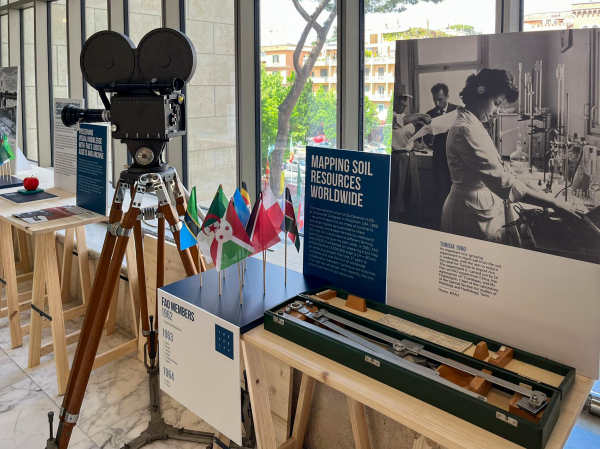
In May, I was honored to attend the next phase of a Constitution Exhibition in Rome – a project that I helped create that celebrates and contextualizes the role of the FAO Constitution in shaping the organization’s operations and aspirations. The exhibition complements my ongoing research and writing on the development of FAO’s constitutional framework from 1943 to 1945, as well as its further development and subsequent application in global food governance through 1965.

Continue reading “Executive Director Roberts on Partnering with the FAO on its Constitution Exhibition”

Renewed FAO/Resnick Center Partnership

by Michael T. Roberts

I am pleased to announce that the Food and Agriculture Organization (FAO) of the United Nations has renewed its partnership with the UCLA Law Resnick Center for Food Law & Policy. An announcement can be found here.

The FAO is the largest and oldest sub-agency of the UN and is headquartered in Rome, Italy. The partnership was initially formed in 2019 when FAO Director-General José Graziano da Silva visited the Center in Los Angeles and spoke at the law school along with Hilal Elver, former UN Special Rapporteur on the Right to Food and a Global Distinguished Fellow at the Center. I am also appreciative of Hilal’s tireless efforts in pulling together this first meeting.

This renewed partnership will elevate the Resnick Center’s role in developmental work conducted by the FAO Development Law Service and complement the Resnick Center’s growing international and comparative food law focus. This focus consists of an upcoming book on international food law and other publications, the development of an online platform to publish best practices in mission-driven food law approaches based on comparative analysis, and a major white paper exploring optimal international public-private strategies in food regulation.

We also look forward to leveraging these projects into strategic collaboration with leading global universities, law firms, and organizations. Finally, as always, we hope to translate these projects and collaboration into opportunities for law students.

From Covid 19 to War in Ukraine: Anatomy of the Global Food Crisis in 2022

by Hilal Elver*

In March 2020 the world was shut down along with much of the global economy to avoid the spread of the powerful virus COVID-19. Suddenly, the so-called “efficient” global food supply chains were dismantled, harvests were left in the soil, food workers returned to their homes, the major organizing principle of supply and demand balance all but disappeared, and quite simply, the global food market as we knew it came alarmingly close to collapse. COVID-19 arrived at a time that food production was historically high, and prices low, but constraints on the movements of people and goods left many people without food, and global food systems entered an unusual stalemate. These results were not entirely unpredictable, but the world was unprepared to cope with the challenge. This was true in many countries and regions in both the Global North and Global South. As a result, the number of hungry people has increased by 150 million since the outbreak of the pandemic.

While the world was still struggling with many variants of Covid-19, and full recovery is not yet in sight, the February 24, 2022, invasion of Ukraine by the Russian Federation brought about a further deterioration in global food trade as these two countries happened to be major players in the global grain market.  Today’s food markets are heavily reliant on international food trade. Since the early 1990s, nearly a quarter of all food produced crosses international borders. The high dependency on global grain imports for the food security of many countries in the Middle East and Africa is causing a severe food crisis in many parts of the world.

FAO State of Hunger and Malnutrition Report 2022

On July 6, 2022, in the middle of multiple unresolved crises, the United Nations Food and Agriculture Organization (FAO), World Food Program (WFP), International Fund for Agriculture Development (IFAD) (Those three are called UN Rome-based institutions), World Health Organization (WHO), and United Nations Children Fund (UNICEF) published their annual flagship report on progress toward ending hunger, achieving food security, and improving nutrition. The major message of the State of Food Security and Nutrition in the World Report (SOFI) was that “the world is moving in the wrong direction” to end hunger, food insecurity, and all forms of malnutrition. The SOFI 2022 report projects that nearly 670 million people, or 8% of the world’s population, will be affected by hunger in 2030, instead of the “zero hunger” target Nr. 2 of the Sustainable Development Goals (SDG) that were adopted by the United Nations in 2015. SOFI assesses the relevance of conflicts, including the most recent war in Ukraine, along with climate extremes and economic shocks. Additionally, for the first time, the report adds growing inequalities as major drivers of food insecurity and malnutrition.

Continue reading “From Covid 19 to War in Ukraine: Anatomy of the Global Food Crisis in 2022”

A Science and Policy Interface in Global Food Governance:

 The High Level Panel of Experts of the World Committee of Food Security

by Hilal Elver*

Global food insecurity is a highly complicated, persistent, and multi-dimensional issue that involves multiple sectors, various players, and policy domains (McKeon 2021). It appears in various ways in the different regions of the world, and it has a vast variety of interdependent underlying structural causes that are also linked to other global issues. In times of massive crises, the international community focuses on establishing effective food governance (McKeon 2015).  The sudden spike of food prices in 2007-2008 created major political uprisings in many developing countries. At that time, improving global food governance became a central focus of international discussions. As a result, in 2009, the Committee of the World Food Security (CFS) (originally created in 1974 as a UN intergovernmental body) was reformed and renewed to serve as a forum for review and follow up for food security policies. Since then, CFS is widely seen as the “foremost inclusive international and intergovernmental platform”for food security and nutrition globally.

Continue reading A Science and Policy Interface in Global Food Governance:

Food waste management in the US, UK and Japan

by Minako Kageyama Tanaka

This is the second of three blog posts by Minako Kageyama Tanaka* on food waste in the US, the UK, and Japan.

Food recovery hierarchy commonality and difference

How do the three countries tackle the food waste issue? The US, the UK and Japan articulate their food waste reduction strategies in their food recovery hierarchies. These hierarchies showcase available food waste reduction and recycling approaches and nudge people to take action in the order of least environmental impacts. Although the recovery steps in the three countries are not the same, the countries share many approaches. For example, all three countries start their hierarchy with the reduction of food waste sources. Redistribution of surplus to people and animals comes next, and recycling is the countries’ third preferable action.

However, each government’s recovery hierarchy differs slightly in its types of methods and actions. For instance, Japan is the only country among the three that specifically mentions using digestates for mushroom beds in its hierarchy. And the UK is the only country that sets landspreading in its hierarchy. These examples highlight these countries’ intentions to promote such recycling methods. 

Continue reading “Food waste management in the US, UK and Japan”

The problem of food waste in the US, the UK, and Japan

by Minako Kageyama Tanaka

This is the first of three blog posts by Minako Kageyama Tanaka* on food waste in the US, the UK, and Japan.

Food waste in the world

Many people pay attention to what they eat, but not to what they did not eat. According to an estimate released by the Food and Agriculture Organization (FAO), one-third of the edible part of food is wasted every year, which amounts to 1.3 billion tons per year. Given that between 720 and 811 million people are facing hunger and 2.37 billion people lack access to sufficient food, the amount of food waste is enormous. Besides, wasting food means wasting resources spent on food production and the supply chain.

To change the global consumption and production patterns in the food industry and its supply chain, the United Nations (UN) has set responsible consumption and production as one of the sustainable development goals (SDGs) and calls for actions to “halve per capita global food waste at the retail and consumer levels and reduce food losses along production and supply chains, including post-harvest losses” by 2030. The global society has only eight years left to achieve that goal.

Continue reading “The problem of food waste in the US, the UK, and Japan”

Commentary – It is Time for the United States to Learn About the Right to Food.

by Hilal ElverMichael T. RobertsDiana R.H. Winters, and Melissa Shapiro

Cross-posted on HilalElver.org

On US Election Day 2021, the state of Maine voted in favor of a constitutional “right to food”—a historic development for a country that has long refused to recognize the human right to food.

Will the US finally acknowledge that this right actually exists?

Maine is officially the first US state to recognize a right to food. On Election Day this year, more than 60% of voters agreed that Maine should amend the state constitution “to declare that all individuals have a natural, inherent and unalienable right to grow, raise, harvest, produce and consume the food of their own choosing for their own nourishment, sustenance, bodily health and well-being.” Put simply, those in Maine will have agency over how they procure their food within the bounds of food safety laws and quality controls. The “right to food” amendment, which was proposed by Rep. Billy Bob Faulkingham (R-Winter Harbor) and received bipartisan support, was welcomed by a diverse constituency comprising small farmers, libertarians, liberals and those who believe that local producers should not have to compete with corporate food interests.

 Observing how Maine practically applies the “right to food” amendment in furtherance of the stated objective is critical. It will be necessary for Maine legislators to work closely with other state agencies to ensure that emerging programs and policies do not violate federal and state laws. It is also important for future decision-making to involve open consultation and participation from civil society and private sector. Being a trailblazer means that the path forward is not always clear; but those who have already dismissed the historic amendment as an empty promise or inoperable language are missing the point: Maine’s constitutional amendment is a transformative step towards the United States’ formal recognition of the human right to food.

Continue reading “Commentary – It is Time for the United States to Learn About the Right to Food.”

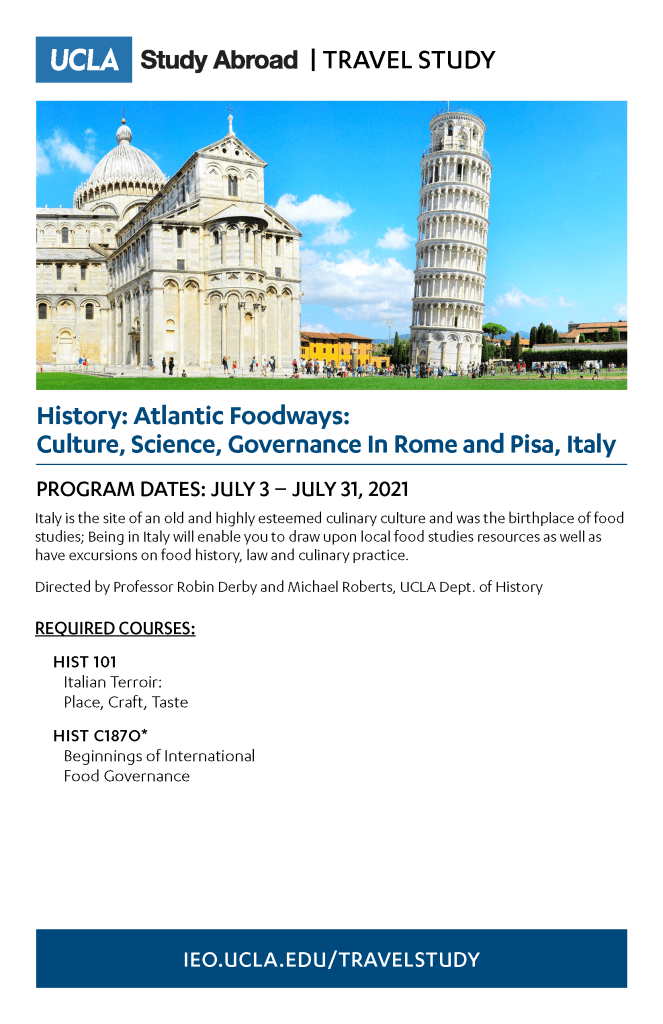
Study Food History and Culture in Italy With UCLA Next Summer

Aaahhh, travel. Let’s dream of July in Rome, experiencing Italy’s food culture and learning Italian food history through the concept of terroir. Study this complex food culture with Robin Derby, Professor of History, UCLA, and Michael Roberts, Executive Director of the Resnick Center for Food Law & Policy, observing sustainable food production, tasting local cuisine, and learning about the emergence of international food governance through the twentieth century. Click here for more information.

The Honey Wars

If you’ve ever tried to buy a jar of manuka honey, you know the price is anything but sweet.  This is because of the honey’s purported health and aesthetic benefits, which have caused its price to skyrocket.  The New York Times recently published an article about a dispute between New Zealand and Australia regarding when honey can be branded “manuka,” and by whom.  Find this fascinating read here.


The Resnick Center and The Promise Institute at UCLA Law Host UN Food and Agriculture Organization Director-General José Graziano da Silva

by Diana R. H. Winters

On February 15, 2019, the Resnick Center for Food Law and Policy and The Promise Institute for Human Rights at UCLA Law hosted the UN Food and Agriculture Organization (FAO) Director-General José Graziano da Silva, who gave a talk titled, “A Global Perspective on Regulating and Promoting Nutrition.”  We were honored to host the Director-General for this important presentation.

In his talk, Graziano da Silva emphasized the critical need for regulation regarding healthy food.  He explained that while there are regulations regarding food safety, global entities have entirely failed to regulate for the nutritional value of food.  The world is grappling with a crisis of malnutrition—a broad concept that includes obesity as well as hunger—and this crisis is exacerbated by the failure of regulation.  Malnutrition costs the world economy between three and five billion dollars a year, which is approximately 3% of the global economy.  This problem must be seen as a public issue, Graziano da Silva said, not an individual one, and it is critical that countries find a way to work together.  This is the foremost challenge the FAO faces.

Graziano da Silva was introduced by Hilal Elver, the Global Distinguished Fellow at the Resnick Center for Food Law & Policy, and the United Nations Special Rapporteur on the Right to Food.  The video recording of the entire event can be found here.

Website Powered by WordPress.com.

Up ↑