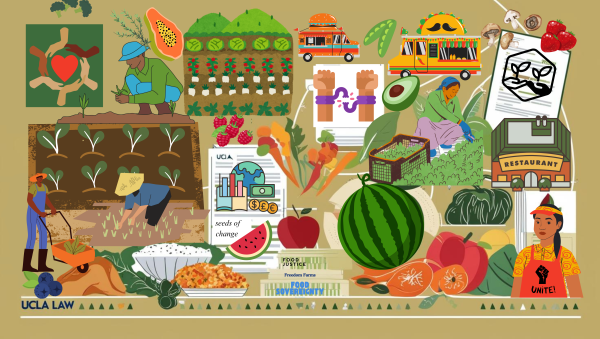
Introducing the Food, Race, and Equity Initiative

by Heliya Izadpanah and Lavanya Sathyamurthy*

This is Part I of a two-part post.

Dreaming of Food Justice in Law

By Heliya Izadpanah

UCLA Law was my dream school. Like many law schools, it catered to my interests in human rights law and environmental law. But what made the decision to attend UCLA Law a no-brainer were two rare institutional assets–its groundbreaking Critical Race Studies program paired with one of the few Food Law programs then existing in the nation.

I was a passionate advocate for food systems justice. We all interact with food daily, yet its production and distribution are rarely observed in modern society. People often don’t know the conditions under which their food is produced or the legal machines maintaining these systems. But when it comes down to it, it’s virtually impossible to identify even a single food item that isn’t riddled with disparities of race, rights, and inequity. From growing food, to harvesting, processing, transportation, access, and health outcomes, every aspect of food systems is steeped in disparities of race, gender, wealth, status, and ability.

As a teenager, I was inspired by Black Power activists and other POC leaders steeped in food systems—Fannie Lou Hamer and the Freedom Farms Collective, Black Panthers like Erika Huggins who created the nation’s first free breakfast program, and Shirley Chisholm, a key architect of WIC and SNAP programs. Similarly, I looked up to the founding organizers of Farmworkers United—Dolores Huerta and Cesar Chavez—for their achievements in food production. Each of these leaders knew the power of food, revealing its power to either hold one in oppression or to act as a focal point for movement building, community power, sovereignty, and emancipation. I was eager to learn how to use law as a tool for food systems justice and get involved in the food law program.

Continue reading “Introducing the Food, Race, and Equity Initiative”
Introducing the Food, Race, and Equity Initiative, Part II

by Heliya Izadpanah and Lavanya Sathyamurthy*

This is Part II of a two-part post.

Why Start Here?

by Lavanya Sathyamurthy


UCLA, home to the Resnick Center for Food Law and Policy and the Critical Race Studies Program, is the perfect place to start a movement focused on infusing issues of equity into food law curricula. The Resnick Center for Food Law and Policy adopts a multi-faceted approach to legal research and scholarship, through courses, conferences, and academic collaboration. The Center offers various classes at the law school. Specifically, the ‘Food Law and Policy Seminar’ exposed me to a wide variety of approaches to food law. As my classmates presented on the right to food and food advertising to children, I realized that food law intersects with every area of law. Immediately, I wanted to connect food law with my background in critical race studies and, more specifically, my experiences as an Asian-American navigating the higher education food landscape. I wrote my paper about the importance of data disaggregation among racial groups within the Asian-American diaspora in crafting solutions to combat food insecurity at the University of California campuses.

Continue reading “Introducing the Food, Race, and Equity Initiative, Part II”

Food, community, and belonging: Our Seat at the Table

by Marin Milken*

[This is one in a series of occasional posts by Los Angeles high school students working with and studying food systems.]

Inspired by the meals I made for my family and friends during the pandemic, I founded Our Seat at the Table to engage with questions of food, community and belonging. Though there are various food-related initiatives that Our Seat will continue to tackle through its programming, I wanted our first endeavor to help with the widespread national issue of food insecurity. Food insecurity, in simplest terms, is when people neither have enough to eat, nor know where their next meal is coming from. The latest State of Food Security and Nutrition in the World (SOFI) report indicates that in comparison to 2019, the number of people worldwide affected by hunger has risen by over 122 million. In the United States, food insecurity is addressed through Supplemental Nutrition Assistance Program (SNAP) benefits, which aim supplement low-income families’ groceries, so that they can access the food that they need to be food secure. But key findings in a recent report from the Robert Wood Johnson foundation highlight and demonstrate that SNAP benefits don’t cover the cost of moderately priced meals in 78% of US counties. With this statistic in mind, it’s unlikely that SNAP benefits are able to cover the costs of healthier options, such as organic produce. Programs such as SNAP – and its inability to adequately address the food needs for so many in this country – highlight a large systemic gap between those who are food insecure and food secure, despite SNAP being touted as a successful safety net for those who are food insecure.

Continue reading “Food, community, and belonging: Our Seat at the Table”

Website Powered by WordPress.com.

Up ↑