
by Heliya Izadpanah and Lavanya Sathyamurthy*
This is Part I of a two-part post.
Dreaming of Food Justice in Law
By Heliya Izadpanah
UCLA Law was my dream school. Like many law schools, it catered to my interests in human rights law and environmental law. But what made the decision to attend UCLA Law a no-brainer were two rare institutional assets–its groundbreaking Critical Race Studies program paired with one of the few Food Law programs then existing in the nation.
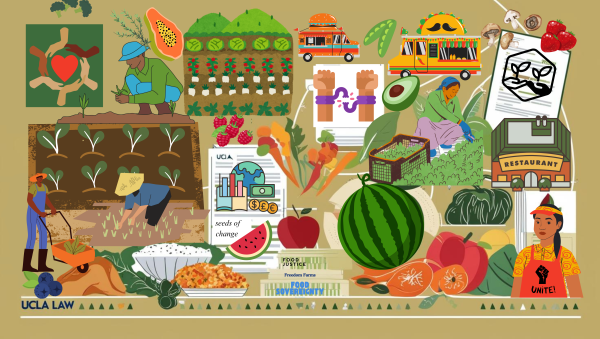
I was a passionate advocate for food systems justice. We all interact with food daily, yet its production and distribution are rarely observed in modern society. People often don’t know the conditions under which their food is produced or the legal machines maintaining these systems. But when it comes down to it, it’s virtually impossible to identify even a single food item that isn’t riddled with disparities of race, rights, and inequity. From growing food, to harvesting, processing, transportation, access, and health outcomes, every aspect of food systems is steeped in disparities of race, gender, wealth, status, and ability.
As a teenager, I was inspired by Black Power activists and other POC leaders steeped in food systems—Fannie Lou Hamer and the Freedom Farms Collective, Black Panthers like Erika Huggins who created the nation’s first free breakfast program, and Shirley Chisholm, a key architect of WIC and SNAP programs. Similarly, I looked up to the founding organizers of Farmworkers United—Dolores Huerta and Cesar Chavez—for their achievements in food production. Each of these leaders knew the power of food, revealing its power to either hold one in oppression or to act as a focal point for movement building, community power, sovereignty, and emancipation. I was eager to learn how to use law as a tool for food systems justice and get involved in the food law program.
Continue reading “Introducing the Food, Race, and Equity Initiative”


 On Food Law
You must be logged in to post a comment.