Chlorpyrifos and state v. national action in food policy

by Diana Winters

A reversal by the Trump administration on proposed restrictions on the use of a commonly used pesticide highlights how state governments may be instrumental in the development of progressive food policy.

The Environmental Protection Agency (EPA) began a reassessment of all organophosphate pesticides in 1996, pursuant to the Food Quality Protection Act (FQPA). The FQPA amended the Food, Drug, and Cosmetic Act (FDCA) and the Federal Fungicide, Insecticide, and Rodenticide Act (FIFRA), under which the EPA regulates pesticides, and required the agency to assess approved pesticides under a stricter standard than it had previously. In 2000, after this reassessment, the EPA signed an agreement with six manufacturers of chlorpyrifos sharply limiting the pesticide’s production for home and garden use, and curtailing its use on certain agricultural products.

After the EPA completed its reassessment process in 2006 and reaffirmed its approval for the remaining uses of chlorpyrifos, the Natural Resources Defense Council (NRDC) and Pesticide Action Network North America (PANNA), filed an administrative petition, asking the agency to ban all uses of the pesticide. In this petition, the groups argued that the EPA had inappropriately reaffirmed the pesticide’s approval despite significant evidence showing that chlorpyrifos was dangerous to humans, especially to children.

The EPA delayed issuing a response to the NRDC/PANNA petition for years. PANNA filed suit in 2010 against the agency, demanding a response, but settled the suit based on a promise by EPA that the agency would issue a final decision by 2011. When it did not, PANNA filed for a writ of mandamus in the Ninth Circuit, which the court denied after the EPA provided a timeline for response. When the EPA again missed its deadline in 2014, PANNA renewed its petition for mandamus. The Ninth Circuit granted this petition, ordering the EPA to respond by October 2015.

In October 2015, the agency proposed to revoke all approvals for chlorpyrifos based on what it saw as unacceptable risk to human health, and supported this decision in November 2016 with an updated human health risk assessment. The agency set March 2017 as a deadline for its final decision on the 2015 proposal.

In March 2017, however, the EPA rejected NRDC and PANNA’s petition on the basis that it needed more time to assess the potential health consequences of the pesticide. The agency stated:

despite several years of study, the science addressing neurodevelopmental effects remains unresolved and that further evaluation of the science during the remaining time for completion of registration review is warranted to achieve greater certainty as to whether the potential exists for adverse neurodevelopmental effects to occur from current human exposures to chlorpyrifos.

In August 2017, the New York Times reported that in the weeks before the agency rejected the petition, Scott Pruitt, appointed head of the EPA by President Trump, had assured industry executives who had been advocating for the continued EPA approval of chlorpyrifos, that it is “a new day, and a new future,” and that he would work with the industry.

Soon after the agency denied the petition, NRDC and PANNA filed for further relief from the Ninth Circuit, arguing that the agency’s denial was inadequate because it was not based on new scientific evidence. Several states including California and New York sought to join the suit in July, but shortly thereafter, the court denied this petition, explaining that by issuing a final decision the EPA had fulfilled the court’s earlier mandate, and the groups now needed to pursue administrative relief before returning to court.

In response to the EPA’s decision, California, which produces the majority of the nation’s produce, has moved to further regulate and restrict the use of chlorpyrifos, and to add the chemical to the list of human health hazards that the state maintains under Proposition 65.

While not ameliorating it completely, California’s action to regulate chlorpyrifos will reduce the impact of the Trump administration’s refusal to move forward with the previously proposed restrictions on this chemical. We see the possibility of meaningful change in the food systems sphere—here through the restriction of a pesticide harmful to producers and consumers—enacted through state, not federal action. In regards to food policy, the state, local, and private spheres will be the arenas to watch in the near future as they work to react to the Trump administration’s anti-regulatory stance, industry focus, and inattention to some of the progressive food policy positions taken by the prior federal administration.

FDA Commissioner Scott Gottlieb Proposes Sweeping Label Updates – COMMENTS OPEN

by Diana Winters

On March 29, FDA Commissioner Scott Gottlieb spoke at the Consumer Federation of America’s National Food Policy Conference about how the agency “can make further improvements in public health by both empowering consumers with information and facilitating industry innovation toward healthier foods that consumers want.” He focused not just on reducing chronic disease, but also on how better information can help to narrow nutrition and health disparities.

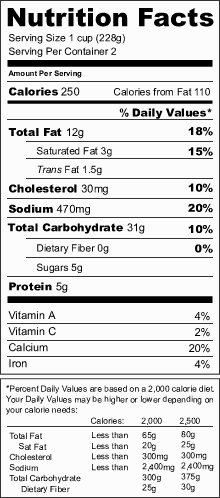
As to specific steps, Commissioner Gottlieb discussed: (1) modernizing health claims, (2) re-defining “healthy”, (3) changing the process by which the agency reviews qualified health claims, (4) clarifying the term “natural”, and (5) modernizing the names for ingredients, and standards of identity. He also talked about implementing the new nutrition facts label and menu labeling rules, and working on reducing sodium in foods.

You can watch the speech here.

For an administration committed to deregulation, Commissioner Gottlieb’s stance is surprising, and exciting. The Center for Science in the Public Interest provided FDA with some great preliminary suggestions for moving forward. I’m opening comments for this post – what do you think about Commissioner Gottlieb’s speech? What should or shouldn’t FDA do?

N.Y. Times on animal antibiotics in animal feed

There was a really interesting article on the use of antibiotics in animal feed in the N.Y. Times last week. Two very interesting takeaways: (1) the article highlights the flaws in FDA’s initiative to prohibit the use of antibiotic for growth promotion—as many critics noted, allowing companies to use these drugs for disease “prevention” is essentially a loophole, and (2) the market is eclipsing regulation in the context of antibiotics, as consumers increasingly demand antibiotic-free meat.

Further reading:

  • Emilie Aguirre wrote about California’s stricter rules and democratic experimentalism here.
  • Lisa Heinzerling wrote about the FDA’s poor record on animal antibiotics here.
  • I link to some resources on the background of this issue in a 2014 blog post, here.

N.Y. Times article: U.S. influence on Nafta talks regarding junk food warning labels

The New York Times reported today that in trade talks with Mexico and Canada, the Trump administration is trying to prevent Nafta’s members, including the United States, from using warning labels on junk food.  In 2016, Chile introduced black stop-sign warnings on food that was high in calories, sodium, sugar, or saturated fat, and the Times reports that Mexico and Canada are considering imposing similar regulations.  Mexico currently has one of the highest death rates from diabetes in the world.  The Office of the United States Trade Representative, however, “is pushing to limit the ability of any Nafta member to require consumer warnings on the front of sugary drinks and fatty packaged foods,” which aligns with the wishes of certain beverage and packaged food manufacturers in the United States.  The article can be found here: https://www.nytimes.com/2018/03/20/world/americas/nafta-food-labels-obesity.html

Media coverage of food desert analysis

by Diana R. H. Winters

Last week, in an article titled “Food deserts may not matter that much,” The Economist reported on a study by three scholars finding that when trying to account for the disparity in eating patterns between rich and poor people, the answer may not be in the availability of healthy food. In “The Geography of Poverty and Nutrition: Food Deserts and Food Choices Across the United States,” Hunt Allcott, Rebecca Diamond, and Jean-Pierre Dubé found that although it is true that “there is a meaningful nutrition-income relationship in grocery purchases,”—that people with more money buy more healthful food—this is not due to the supply, or lack thereof, of healthy food in lower income neighborhoods. The authors looked at the effect of the entry of new stores carrying healthy food options into neighborhoods that had previously had fewer healthy options, concluding that there was little effect “on the composition of the shopping basket.” This is because people were willing to drive to supermarkets if there were no supermarkets in their neighborhoods. A new market may reduce transport costs, but did not change individual preferences. These findings cast doubt on the “food desert” hypothesis, which explains the fact that poor people eat less healthfully by pointing to the lower availability of healthy food in lower income neighborhoods.

This is not the first study to question the food desert hypothesis. Earlier studies have found, among other things, that putting new stores into underserved neighborhoods without other interventions to change shopping and eating habits may not have the effect on dietary choices or obesity rates that had been predicted. In this extremely comprehensive new study, the authors buttressed policy suggestions with rigorous empirical work. They found, as did the earlier studies, that changing demand was more important than changing supply, and that increasing people’s knowledge about food could be an important driver of change. For this reason, “policies geared toward nutrition education may be more effective than subsidies and grants geared toward food retailers.”

The policy conclusion that public money is better spent in education than in retail is a significant one, and a progressive one. The coverage of this study in The Economist, however, is anything but. Instead, the article’s focus, encapsulated by its title, is that the availability of healthful food may not affect food-related health outcomes as much as once thought. Instead, the article tells us that it is preference, not availability, which drives food purchasing. Although it notes that preference may be influenced by education, the article does not mention that the authors of the study it covers emphasize the need to shift our food policy dollars. And without noting that preference itself is formed by historical forces, including generations of poor supply and lack of access to education about nutrition in lower income neighborhoods, readers are left to assume that a preference for unhealthy food is an individual and personal failure.   By doing this, The Economist’s article erases the institutionally supported and sanctioned inequality that partially created the obesity epidemic and its related problems, reinforces the perception that government has no place in food policy, and shifts the burden from public to private responsibility for the solution.


Government subsidized loan programs for chicken facilities and Becerra v. The Coca-Cola Co.

Late last week I read two interesting short pieces on food law, one an email to a listserve by Susan Schneider, a Professor of Law and the Director of the LL.M. Program in Agricultural & Food Law at the University of Arkansas School of Law on using government subsidized loans to build chicken facilities for contract production, and one a Public Citizen blog post by Stephen Gardner, former litigation director for the Center for Science in the Public Interest, criticizing the Northern District of California District Court’s recent opinion in Becerra v. Coca-Cola. 

Professor Schneider wrote the following:

For a long time, I have questioned the use of government subsidized loan programs through USDA and SBA to fund the huge loans needed to build chicken facilities for contract production.  As noted in Food, Farming, & Sustainability, I have argued that those loans supported the one-sided contracts that are used throughout the industry. Lenders would rarely fund operations based on these short term and risk laden contracts without a government guarantee.  In this regard the subsidized lending programs, designed to help small business, have actually been used to support the integrated industry. 

The SBA Office of Inspector General has just published a report that lends support to this analysis. It provides a good description of the contractual relationship, the risks associated with the contract terms, and the role of  SBA in supporting this system of production. And, it is a fascinating look at the billions of dollars of SBA loans going to poultry growers. It finds that the control exercised by the integrator is so extensive that the integrator and the grower are “affiliated enterprises,” and that as such, about $1.8 billion in loans should have been ineligible.  “SBA guaranteed loans to affiliative enterprises are inconsistent with its stated mission to assist small business concerns.”  

For anyone writing or teaching about the system that produces our inexpensive and abundant  supply of poultry, I highly recommend this report. 

Evaluation of SBA 7(A) Loans Made to Poultry Farmers, SBA OIG, Rep. No. 18-13 (Mar. 6, 2018). 

Appreciation to Politico, Morning Ag Report for bringing this report to my attention.


The link to Mr. Gardner’s piece is here: http://pubcit.typepad.com/clpblog/2018/03/illustration-of-the-problem-of-judges-substituting-their-own-opinions-of-facts.html


Bringing Sustainable Plant-Based Eating to the Planet–David Yeung talks at UCLA Law

by Cheryl Leahy, The Initiative on Animals in Our Food System, Resnick Program for Food Law and Policy

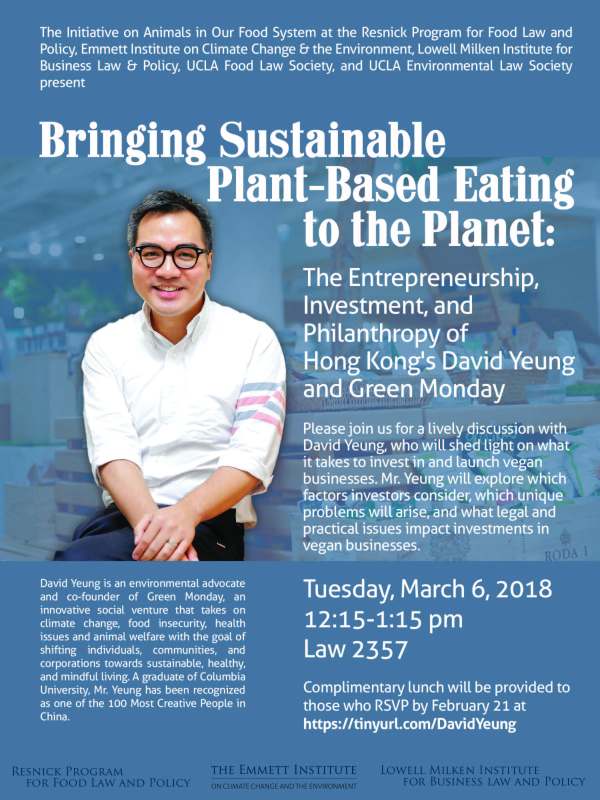
The Initiative on Animals in Our Food System at the Resnick Program for Food Law and Policy hosted a discussion with David Yeung titled, “Bringing Sustainable Plant-Based Eating to the Planet: The Entrepreneurship, Investment, and Philanthropy of Hong Kong’s David Yeung and Green Monday” on March 6th at UCLA. Mr. Yeung is an award-winning social entrepreneur whose companies, Green Monday, Green Common, and Green Monday Ventures, take different approaches to solving the same problem – how to bring sustainable vegan eating to the planet. He jokingly nicknamed his companies the “Swiss army knife” of green and sustainable eating, for the diversity and efficacy of their approaches.

Mr. Yeung presented historical and factual background on the environmental and health impacts of animal agriculture and consumption and explained how he himself learned about the enormous effects the production of meat for human consumption has on the earth. He explained how cultural and market forces can be key tools in achieving change, an understanding of which led him to the launching of his companies.

Mr. Yeung imagined Green Monday as a way to reach a broad audience, asking people to reduce their animal product consumption at least one day per week as an intermediary stepping-stone to an increased reduction. Green Monday and its related companies accomplish this by partnering with institutions, including schools, restaurants, and corporations, as well as by running storefront sales showcasing plant-based foods from around the world, and by investing in and developing vegan companies and products. Since its inception six years ago, Green Monday’s reach has grown to 33 countries, with 1.6 million participants in its Hong Kong home.

David Yeung at UCLA Law

The Initiative on Animals in Our Food System at the Resnick program for Food Law and Policy, Emmett Institute on Climate Change & the Environment, Lowell Milken Institute for Business Law & Policy, UCLA Food Law Society, and UCLA Environmental Law Society invite you to hear David Yeung on Bringing Sustainable Plant-Based Eating to the Planet.  At this event, Mr. Yeung will discuss investing in and launching vegan businesses, exploring investment factors, unique problems, and legal and practical issues.

Tuesday, March 6, 2018

12:15-1:15pm

NEW LOCATION:      W.G. Young Hall, Room CS76

UCLA South Campus (across from Parking Structure 2)


Website Powered by WordPress.com.

Up ↑