The intersection of pedagogy and practice: an interview with Duke Law Professor Allison Korn

By Lavanya Sathyamurthy*

In law school classrooms across the country, professors and students grapple with society’s most challenging issues and how to address them through the legal system. How can we ensure access to reproductive healthcare after the Supreme Court eliminated the constitutional right to abortion inDobbs v. Jackson Women’s Health Organization? How can we meet the needs of our unhoused population when several cities, including Los Angeles, have passed ordinances that ban camping on public property, criminalizing homeless encampments? Through these discussions, students are introduced to important concepts such as community lawyering, which encourages lawyers to work collaboratively with impacted communities, and cultural competency, which describes the ability to work effectively with people from different backgrounds. Theoretical discussions in seminars provide the basis for how students will eventually approach social justice issues in practice. However, the most fruitful learning opportunities arise at the intersection of pedagogy and practice, in clinical courses.

Clinical courses are a cornerstone of the law school curriculum. In the classroom, students learn both legal theories, such as abolition in the criminal context, and practical skills, such as client interviewing and legal research. In the field, they apply this knowledge to serve clients, taking on primary responsibility for every aspect of their case. Through these courses, students learn how to translate theory into practice to zealously advocate for their clients. Clinics also serve an important role in the community, offering assistance to and building relationships with local marginalized populations.

Continue reading “The intersection of pedagogy and practice: an interview with Duke Law Professor Allison Korn”


Executive Director Roberts on Partnering with the FAO on its Constitution Exhibition

by Michael T. Roberts

This post is the first of two by Executive Director Roberts on the FAO’s constitutional framework.

The Resnick Center is honored to be a partner to the Food and Agriculture Organization of the United Nations (FAO). The FAO was established in 1945 when its Constitution was signed and ratified by nations meeting in Quebec, Canada.  It was created as part of U.S. President Franklin D. Roosevelt’s broader efforts to advance the “Freedom from Want,” an aspiration he articulated in response to the catastrophic human suffering caused by hunger and malnutrition. The vision of an international organization grounded in governance principles was also central to the post-World War II global reordering.

In May, I was honored to attend the next phase of a Constitution Exhibition in Rome – a project that I helped create that celebrates and contextualizes the role of the FAO Constitution in shaping the organization’s operations and aspirations. The exhibition complements my ongoing research and writing on the development of FAO’s constitutional framework from 1943 to 1945, as well as its further development and subsequent application in global food governance through 1965.

Continue reading “Executive Director Roberts on Partnering with the FAO on its Constitution Exhibition”

To Eat or Not to Eat: For Consumers in a City Without a Food Allergen Ordinance, The Choice Could Be Life or Death

by Melissa Deng*

For many of us without food allergies, we don’t think twice about choosing to dine at a restaurant or order take-out––often, the biggest concern is picking which restaurant you feel like eating at, what to order, and comparing costs.  But for individuals with food allergies, the choice between dining in and ordering out can mean life or death.  Even so, cities you might think are more “food allergy-friendly” like Los Angeles, which has a colloquial reputation for having a vibrant food scene, may not have an ordinance specifically governing food allergen training in restaurants––even while more than fifty percent of adults with food allergies and over forty percent of children with food allergies in the United States have experienced a severe food allergic reaction (of note is that emergency treatment for anaphylaxis resulting from a food allergic reaction increased by 377 percent between 2007 and 2016). 

What gives?  For starters, the restaurant industry is of course profit-driven, and restaurant associations have a significant impact on lobbying for or against legislation.  From an economic perspective, restaurant management might be wary of the increased costs an ordinance specifically mandating food allergen training would impose, compounded by the fact that the restaurant industry generally experiences high turnover (reportedly, there was a 28% average turnover rate for restaurants in LA last year).  From a legal perspective, restaurants might not want to face increased liability: with an ordinance that mandates training, plaintiffs can more easily make a prima facie case of negligence by showing that the restaurant’s conduct deviated from an established standard of care.  And from a psychological perspective, restaurant staff might have misconceptions about their role in preventing food allergic reactions (for example, believing that the onus falls solely on customers to order a dish that doesn’t have food allergens) and might not realize the potentially fatal consequences, such as anaphylaxis resulting from a food allergic reaction.   What this means is that consumers with food allergies are unfairly subjected to a burdensome and dangerous dining experience where each restaurant chooses which food allergen procedures to follow and to what degree. 

It is precisely this issue that drove us at the Resnick Center for Food Law & Policy, in collaboration with a professor and clinical immunologist at UCLA, to begin collecting both hospital-based and anecdotal evidence on instances of food-related anaphylaxis in the city, and pursuing the task of proposing a food allergy ordinance in the City of Los Angeles that will mandate a separate food allergen training for all restaurant employees in the city.  In the beginning stages of the project, we sought to answer two underlying questions: how do restaurants communicate allergen information to their consumers; and are they effectively training their personnel in allergen disclosure for menu labeling or food handling?

Continue reading “To Eat or Not to Eat: For Consumers in a City Without a Food Allergen Ordinance, The Choice Could Be Life or Death”

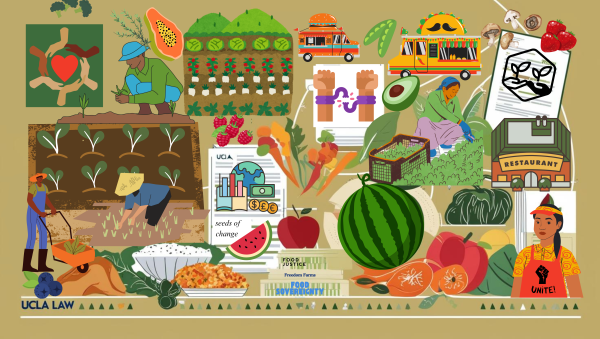
Introducing the Food, Race, and Equity Initiative

by Heliya Izadpanah and Lavanya Sathyamurthy*

This is Part I of a two-part post.

Dreaming of Food Justice in Law

By Heliya Izadpanah

UCLA Law was my dream school. Like many law schools, it catered to my interests in human rights law and environmental law. But what made the decision to attend UCLA Law a no-brainer were two rare institutional assets–its groundbreaking Critical Race Studies program paired with one of the few Food Law programs then existing in the nation.

I was a passionate advocate for food systems justice. We all interact with food daily, yet its production and distribution are rarely observed in modern society. People often don’t know the conditions under which their food is produced or the legal machines maintaining these systems. But when it comes down to it, it’s virtually impossible to identify even a single food item that isn’t riddled with disparities of race, rights, and inequity. From growing food, to harvesting, processing, transportation, access, and health outcomes, every aspect of food systems is steeped in disparities of race, gender, wealth, status, and ability.

As a teenager, I was inspired by Black Power activists and other POC leaders steeped in food systems—Fannie Lou Hamer and the Freedom Farms Collective, Black Panthers like Erika Huggins who created the nation’s first free breakfast program, and Shirley Chisholm, a key architect of WIC and SNAP programs. Similarly, I looked up to the founding organizers of Farmworkers United—Dolores Huerta and Cesar Chavez—for their achievements in food production. Each of these leaders knew the power of food, revealing its power to either hold one in oppression or to act as a focal point for movement building, community power, sovereignty, and emancipation. I was eager to learn how to use law as a tool for food systems justice and get involved in the food law program.

Continue reading “Introducing the Food, Race, and Equity Initiative”

Introducing the Food, Race, and Equity Initiative, Part II

by Heliya Izadpanah and Lavanya Sathyamurthy*

This is Part II of a two-part post.

Why Start Here?

by Lavanya Sathyamurthy


UCLA, home to the Resnick Center for Food Law and Policy and the Critical Race Studies Program, is the perfect place to start a movement focused on infusing issues of equity into food law curricula. The Resnick Center for Food Law and Policy adopts a multi-faceted approach to legal research and scholarship, through courses, conferences, and academic collaboration. The Center offers various classes at the law school. Specifically, the ‘Food Law and Policy Seminar’ exposed me to a wide variety of approaches to food law. As my classmates presented on the right to food and food advertising to children, I realized that food law intersects with every area of law. Immediately, I wanted to connect food law with my background in critical race studies and, more specifically, my experiences as an Asian-American navigating the higher education food landscape. I wrote my paper about the importance of data disaggregation among racial groups within the Asian-American diaspora in crafting solutions to combat food insecurity at the University of California campuses.

Continue reading “Introducing the Food, Race, and Equity Initiative, Part II”

The Poisoning of the Gerber Generation:

How Public Nuisance Law Could Address Heavy Metals in Baby Food in the Face of Regulatory Failure

by Lillian Matchett*

A cheerful jingle plays as beaming babies flash across a white background.  These children are the “Gerber Generation,” the voiceover tells you, and they have some big news to share: the nutrition they get in their first five years of life can affect their health forever.   “Think about that,” they say.

Gerber launched its Gerber Generation campaign in 2010 in the face of increased attention on childhood obesity, focusing on the health and nutritional needs of young children at a vital point in their development.  Gerber was right: what a child consumes in the first few years of their life is critically important, but as it turned out, there were other substances in at least some of the Gerber Generation’s food that could have a profound and lasting impact on children’s health.  In 2021, Gerber was one of several companies exposed for selling baby food containing concerning levels of heavy metals—toxins which, even in small amounts, can cause severe and irreversible cognitive impairment and physical illness in young children.

In 2021, a congressional subcommittee issued two reports finding high levels of heavy metals—lead, arsenic, cadmium, and mercury—in commercial baby foods from seven major manufacturers.  Heavy metals were present in baby foods from all companies, often at concentrations many times than that allowed under existing regulations for other food products.  The reports also illuminated failures of industry self-regulation, revealing that companies largely do not test their final products and often do not adhere to their own internal standards. 

Predictably, a deluge of litigation followed the release of the Congressional Reports.  Despite well-documented findings of high heavy metal levels in baby food and the known effects those substances have on children, lawsuits have thus far been mostly unavailing, failing on issues of causation and standing, though many are still making their way through the courts.  Regulatory and legislative solutions have also fallen short.  The FDA and Congress attempted to address the issue, but the FDA’s response has been slow and unenforceable, while legislation lacks bipartisan support, and has stalled in committee. 

Continue reading “The Poisoning of the Gerber Generation:”

Exploring the Legal and Policy Implications Behind ‘High on the Hog’: Potential Solutions Forward (Part 4 of 4)

There are a variety of policy solutions that have the potential to help elevate and preserve Black cuisine and resolve inequities faced by Black Americans in the American food system. This post will explore ideas that relate to the preservation of Black culinary tradition, supporting Black farmers and culinary professionals, and increasing the access of culturally-relevant foods to Black communities in order to honor the richness of America’s culinary landscape. 

Preservation of Black Culinary Traditions

The preservation of Black culinary traditions is important to ensure that Black communities are able to celebrate their cultural heritage and to allow for greater recognition of Black people’s contributions to the culinary world. Initiatives like funding programs and grants to support culinary research, education, and documentation of traditional Black food practices could help with this cultural preservation. Furthermore, educational initiatives that introduce Black American cuisine into school curricula have the ability to educate young people about the cuisine’s significance and influence on American food. FoodCorps is an AmeriCorps grantee that has begun undertaking this type of initiative. During black history month of this year (February 2023), the organization held educational programming at elementary schools which taught black history through a culinary lens. 

Continue reading “Exploring the Legal and Policy Implications Behind ‘High on the Hog’: Potential Solutions Forward (Part 4 of 4)”

Exploring the Legal and Policy Implications Behind ‘High on the Hog’: Black Farmers, Land Loss and Its Implications (Part 3 of 4)

Throughout “High on the Hog”, one can see a deep connection between Black American culinary traditions and farming. However, this connection has been threatened by a variety of policies that have limited Black American land ownership and access. For example, certain policies by the USDA, which has earned itself a description as “the last plantation,” such as allowing local (mostly white) farmers to determine Black farmers’ eligibility for USDA funding, have led to Black Americans’ loss of land. In Pigford v. Glickman, the racial discrimination class-action brought against the USDA by Black farmers, the USDA agreed to the largest civil-rights settlement in U.S. history of $1.25 billion. However, many eligible Black farmers have not been compensated

The number of Black farmers in America has decreased dramatically over the past 100 years, with less than 2 percent of farms in the United States owned or operated by Black Americans. This figure is a significant decrease from 1920, when 14.3% of American farms were operated by Black farmers. While there was a small increase in the number of Black farmers from 1.3% to 1.4% between 2007 and 2012, both Black rural and urban farmers continue to face challenges including land access, zoning laws, and financing. Public policies in the agricultural sector have historically disproportionately favored large-scale farmers and contributed to the marginalization of Black farmers. 

Continue reading “Exploring the Legal and Policy Implications Behind ‘High on the Hog’: Black Farmers, Land Loss and Its Implications (Part 3 of 4)”

Exploring the Legal and Policy Implications Behind ‘High on the Hog’: Intellectual Property and Cultural Erasure (Part 2 of 4)

In “High on the Hog” episode three, we learn the stories of Hercules Posey and James Hemings, the enslaved private chefs of George Washington and Thomas Jefferson respectively. They were widely known and widely praised, yet there are no written recipes attributed to either chef. In Stephen Satterfield’s conversation with Hatchet Hall chefs Brian Dunsmoor and Martin Draluck, the chefs hint at the idea that Martha Washington’s widely praised recipe books may in fact contain recipes developed by the enslaved Hercules. 

Dishes like macaroni and cheese have become an American staple, yet most Americans are unaware that the dish was perfected and popularized by Hemings. Black Americans have long been culinary pioneers in this country and have shaped American cuisine at large. The erasure of Black American’s culinary contributions diminishes Black people’s role in America’s cultural tapestry and perpetuates the idea that Black cuisine is isolated from American cuisine at large. 

Furthermore, cultural erasure of Black culinary traditions is a significant risk because Black communities historically have faced limited access to resources and opportunities in the food industry. Unequal access to capital and credit have likely hindered the ability of Black chefs, restaurateurs, and food entrepreneurs to establish and grow their businesses. The lack of representation and access further perpetuates the erasure of Black culture within the food industry and hampers the promotion and preservation of Black culinary traditions.

Continue reading “Exploring the Legal and Policy Implications Behind ‘High on the Hog’: Intellectual Property and Cultural Erasure (Part 2 of 4)”

Introducing a New Food Law Course: The Public Interest in Agroecological Food Systems

The Resnick Center is excited to introduce a new food law course at UCLA School of Law this fall called “The Public Interest in Agroecological Food Systems: An Investigation,” led by Professor Paula Daniels. This seminar is designed to explore the world of agroecology and public policy approaches to institutionalizing its tenets within the US food system.

In the United States, the modern food system is mostly a private industry, with little public investment and fragmented efforts focused on food access and farm-level grant programs. This course aims to address this disparity by exploring opportunities for public sector engagement and directing the food system towards a holistic approach that aligns with public interest values such as environmental sustainability, worker well-being, small farm viability, and community health.

The course will provide a thorough examination of agroecology as a holistic and integrated approach to sustainable agriculture and food systems. Through case studies and guest lectures, students will gain insight into the underlying principles of agroecology and its practical application. The course will also analyze public policy and program approaches required to institutionalize these principles within the US food system.

For more information, please contact the Resnick Center at resnickcenter@law.ucla.edu.  We encourage any student interested in advocating for a more sustainable and equitable food system to sign up this fall!

Website Powered by WordPress.com.

Up ↑