Safe to Eat? States vs. Feds in the Food Dye Debate

by Candace Yamanishi*

There is a shifting sentiment against the use of synthetic food dyes in the US food supply. As citizen-led advocacy groups have been raising their voices about the health concerns of artificial food dyes, several states have introduced or passed legislation banning or limiting the use of certain synthetic food dyes in food products. These efforts reflect the growing concerns over links between artificial dyes (such as Red No. 3, Yellow No. 5, and others) and potential effects on children’s learning and attention, as well as possible risk of carcinogenic effects. These state-wide initiatives have now captured the attention of the federal government and the larger food industry as a whole. Since the U.S. Food and Drug Administration (FDA) maintains nationwide regulatory authority over food additives, a crucial question emerges: can state bans and restrictions on FDA approved food dyes stand, or will they be preempted by federal law?

Continue reading “Safe to Eat? States vs. Feds in the Food Dye Debate”

The Poisoning of the Gerber Generation:

How Public Nuisance Law Could Address Heavy Metals in Baby Food in the Face of Regulatory Failure

by Lillian Matchett*

A cheerful jingle plays as beaming babies flash across a white background.  These children are the “Gerber Generation,” the voiceover tells you, and they have some big news to share: the nutrition they get in their first five years of life can affect their health forever.   “Think about that,” they say.

Gerber launched its Gerber Generation campaign in 2010 in the face of increased attention on childhood obesity, focusing on the health and nutritional needs of young children at a vital point in their development.  Gerber was right: what a child consumes in the first few years of their life is critically important, but as it turned out, there were other substances in at least some of the Gerber Generation’s food that could have a profound and lasting impact on children’s health.  In 2021, Gerber was one of several companies exposed for selling baby food containing concerning levels of heavy metals—toxins which, even in small amounts, can cause severe and irreversible cognitive impairment and physical illness in young children.

In 2021, a congressional subcommittee issued two reports finding high levels of heavy metals—lead, arsenic, cadmium, and mercury—in commercial baby foods from seven major manufacturers.  Heavy metals were present in baby foods from all companies, often at concentrations many times than that allowed under existing regulations for other food products.  The reports also illuminated failures of industry self-regulation, revealing that companies largely do not test their final products and often do not adhere to their own internal standards. 

Predictably, a deluge of litigation followed the release of the Congressional Reports.  Despite well-documented findings of high heavy metal levels in baby food and the known effects those substances have on children, lawsuits have thus far been mostly unavailing, failing on issues of causation and standing, though many are still making their way through the courts.  Regulatory and legislative solutions have also fallen short.  The FDA and Congress attempted to address the issue, but the FDA’s response has been slow and unenforceable, while legislation lacks bipartisan support, and has stalled in committee. 

Continue reading “The Poisoning of the Gerber Generation:”

New Scholarship: The New Food Safety

by Diana Winters

Emily M. Broad Leib and Margot Pollans recently posted The New Food Safety, forthcoming in the California Law Review, on SSRN.  The article argues for a comprehensive definition of “food safety” that encompasses “acute ingestion-related illness” (narrow food safety), “whole-diet, cumulative ingestion-related risks that accrue over time” (intermediate food safety), and “risks that arise from food production or disposal” (broad food safety).  The articles discusses why our current divided regulatory approach is problematic, and may actually exacerbate food-related harms.  In addition to calling for an expanded definition of “food safety,” the article proposes better interagency coordination and the creation of a single Food System Safety agency.

This compelling work  is applicable outside of the context of food, and will appeal broadly to scholars of the regulatory space.

Food Law News

Today was just chock full of food law & policy news.

1. The Supreme Court turned down challenges to two of California’s animal welfare laws: A) Proposition 2, California’s Prevention of Farm Animal Cruelty Act, which mandates that the state’s farm animals need be able to “turn around freely, lie down, stand up, and fully extend their limbs,” and B) CA’s foie gras ban.

The New Food Economy has a good summary of these laws and the challenges here: https://newfoodeconomy.org/supreme-court-animal-welfare-law-cage-free-egg-foie-gras-ban/

2. A federal judge in Iowa found the state’s “ag gag” law unconstitutional, saying that it violates the First Amendment.  https://www.desmoinesregister.com/story/money/agriculture/2019/01/09/ag-gag-law-iowa-struck-down-federal-judge-ia-agriculture-first-amendment-free-speech-puppy-mills/2527077002/

3. The government shutdown’s effect on food safety inspections has been widely noted: https://thehill.com/homenews/administration/424562-fda-says-most-food-inspections-have-been-halted-amid-shutdown.  FDA Commissioner Scott Gottlieb weighed in on Twitter, however, to explain that the FDA has NOT stopped inspections, but has postponed a small amount of routine inspections.  He wrote, “Food Safety During Shutdown: We’re taking steps to expand the scope of food safety surveillance inspections we’re doing during the shutdown to make sure we continue inspecting high risk food facilities. 31% of our inventory of domestic inspections are considered high risk…”

See thread: https://twitter.com/SGottliebFDA/status/1083055700593516545

He also explained, “We wouldn’t have conducted inspections during the 2 weeks around Christmas and New Years, so this is really the first week where there might have been *some* inspections postponed while we put in place mechanisms to continue high risk food surveillance inspections during shutdown”

For more discussion on the background of food safety inspections, and for fantastic food policy tweeting in general see Politico’s Helena Bottemiller Evich’s tweets: https://twitter.com/hbottemiller


Notes from South Korea

by Michael T. Roberts

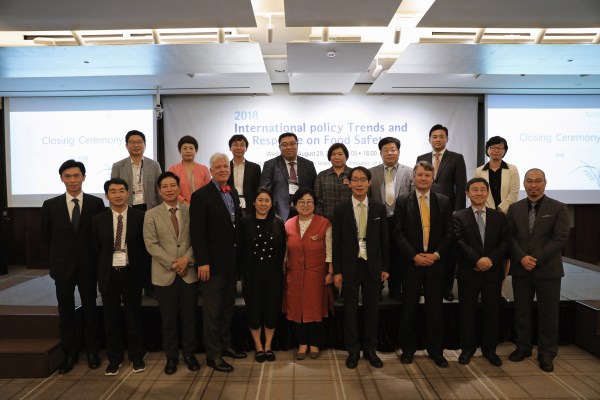
On August 28, 2018, I participated in a roundtable discussion and spoke at a conference in South Korea sponsored by the National Food Safety Information Service (NFSI). As best as I can tell, this conference was the first in South Korea. The roundtable provided an excellent opportunity for me to listen first-hand to concerns about food regulation in South Korea.  The conference included academics working with NFSI as well as South Korean government officials. My assigned topic at the conference was Consolidation of Food Safety Regulation: Historical and Contemporary Considerations. My presentation addressed the current Trump proposal on June 21, 2018, to consolidate the administration of food safety regulation into the USDA and to rename FDA to Federal Drug Administration. This issue is very pertinent to South Korea, where there exists a high degree of fragmentation of food safety regulation.

NFSI is funded by the South Korean government. The organization comprises experts (mostly PhDs) who work closely with the Korean FDA and other agencies with jurisdiction over food safety regulation in Korea. I enjoyed getting to know officials of NFSI: Yun-Hee Chung, the President; Joohyung Lee, the Department Manager; and Soyoung Gwon, a Principal Researcher.

I very much appreciated the gracious hospitality of our hosts and look forward to further interaction with NFSI and others in South Korea in the pursuit of good governance of food.


Website Powered by WordPress.com.

Up ↑