
This post is the first of two by Executive Director Roberts on the FAO’s constitutional framework.
The Resnick Center is honored to be a partner to the Food and Agriculture Organization of the United Nations (FAO). The FAO was established in 1945 when its Constitution was signed and ratified by nations meeting in Quebec, Canada. It was created as part of U.S. President Franklin D. Roosevelt’s broader efforts to advance the “Freedom from Want,” an aspiration he articulated in response to the catastrophic human suffering caused by hunger and malnutrition. The vision of an international organization grounded in governance principles was also central to the post-World War II global reordering.
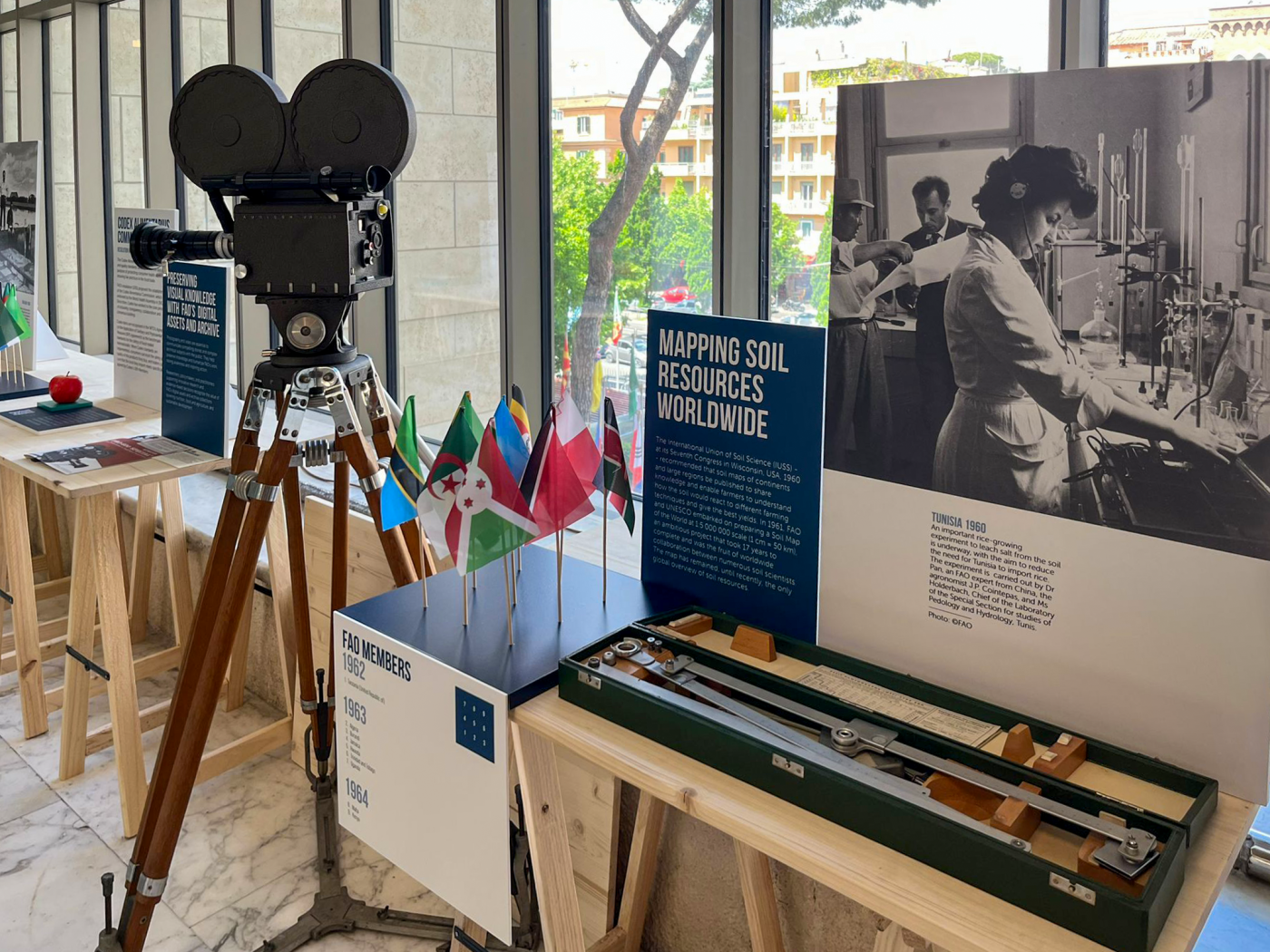
In May, I was honored to attend the next phase of a Constitution Exhibition in Rome – a project that I helped create that celebrates and contextualizes the role of the FAO Constitution in shaping the organization’s operations and aspirations. The exhibition complements my ongoing research and writing on the development of FAO’s constitutional framework from 1943 to 1945, as well as its further development and subsequent application in global food governance through 1965.
The idea for the exhibition was conceived by FAO Director-General Dr. Qu Dongyu, and I was invited to participate in its creation by FAO’s Chief Legal Counsel, Donata Rugarabamu. I greatly enjoyed collaborating with the outstanding FAO Library staff and Office of Communications in curating the exhibition. The first phase of the exhibition was inaugurated by Dr. Qu during the World Food Forum at FAO Headquarters in October 2024, which I had the privilege of attending. I was also pleased to meet with Dr. Qu in May at the opening of the second phase and to hear of his interest in the constitutional foundations of the FAO and the role of governance in shaping today’s global food systems.
Donata Rugarbamu and I co-authored the inscriptions printed on placards displayed in both phases of the exhibition. The inscription from the first phase is included below. The photo below shows me standing next to the placard from the second phase. I look forward to the future phases of the Constitution Exhibition and to our continuing partnership with FAO in educating both the public and the legal community about the transformative role a constitutional framework can play in shaping equitable, effective, and enduring food systems worldwide.
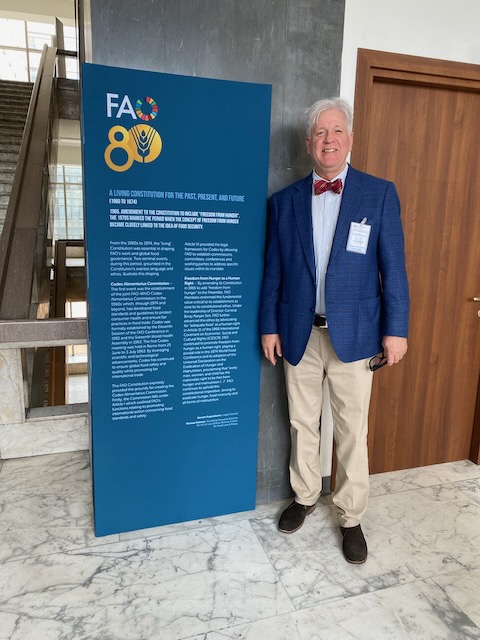
Inscription:
A Living Constitution for the Past, Present, and Future
The Interim Commission of the United Nations on Food and Agriculture (1943-45) was charged by the United Nations Conference on Food and Agriculture (1943) (“Hot Springs Conference”) to organize a permanent organization that followed recommendations made by the forty-four member nations of the Hot Springs Conference. When the Interim Commission convened on 15 July 1943 in Washington, D.C., its primary assignment was to draft a Constitution. The Interim Commission successfully discharged this mission on 16 October 1945, when thirty-four countries signed the Constitution in Quebec, Canada, officially launching FAO. The United Nations was officially established on 24 October 1945, shortly after FAO’s start. FAO became a specialized agency of the United Nations on 14 December 1946.
The Interim Commission delegated the drafting of the Constitution to Committee B, led by Sir Girja Baipai of India. C. Wilfred Jenks, a lawyer for the International Labour Organization (ILO) in Geneva at the time, was crucial in assisting Committee B. The drafters carved out articles (often referred to as the “machinery”), complemented by aspirational provisions in the Preamble (drawn from a Declaration published by the Hot Springs Conference in its final report), designed to form an adaptable FAO.
Despite differences of opinion over the nature of FAO amongst the representatives of the member nations, there was a consensus that the Constitution would be a “living constitution,” ensuring that FAO would remain relevant and responsive to new and future global food and agriculture needs and values. Amendments to the FAO Constitution, such as adding the phrase “freedom from hunger” to the Preamble in 1965 in response to the FAO’s Freedom from Hunger Campaign and amendments in 1991 and 2009 that strengthened FAO’s focus on global food security and governance, demonstrate this functional responsiveness.
Whatever the future of FAO, the Constitution will likely play a critical role in shaping it.
 On Food Law
You must be logged in to post a comment.